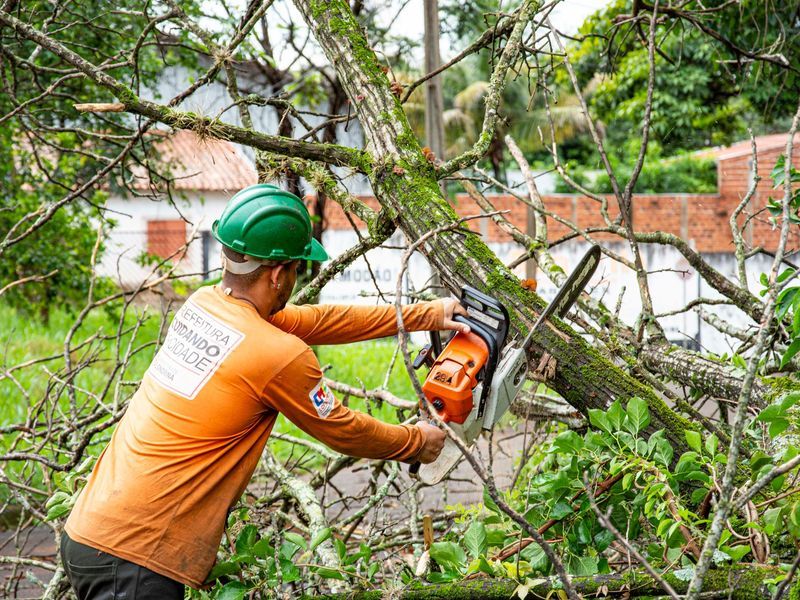
A tree’s location can matter as much as its condition. These steps help Omaha homeowners find out whether a tree is private, public, or subject to local rules before removal.
Before hiring a crew, work out whether the tree is wholly on your property or in a public planting strip, along a street, or on city land. A tree near the sidewalk isn’t automatically a private tree, and a property line can be hard to judge by eye. Check your survey or ask the city if ownership is unclear.
For Omaha city trees and right-of-way questions, contact the City of Omaha Public Works Department. Explain where the tree is and ask which office handles approval or inspection. Don’t rely on a contractor’s guess about who owns it; confirm with the city before cutting.
Requirements can depend on the site and the reason for removal. A tree on a private lot may raise different questions from a street tree, a tree connected to a development project, or one covered by a neighborhood or property restriction. Historic districts, homeowners’ association rules, and construction plans can add separate checks.
This is not a blanket statement that every private tree in Omaha needs a permit—or that none do. Rules can change, and the right answer depends on the address and circumstances. Ask Omaha’s Planning Department or Public Works which city office has authority for your situation and whether a permit, review, or replacement planting applies.
Omaha’s rules don’t automatically apply in Bellevue, Papillion, La Vista, Ralston, Gretna, or Council Bluffs. For a tree in a public right-of-way, contact that city’s Public Works Department or the department responsible for parks and urban forestry. For a private tree tied to construction or a land-use application, ask the city planning or community development office.
Give the office the property address and describe the tree’s position, size, and reason for removal. Ask whether the tree is public or private, whether permission is required, and whether replacement planting or a site-plan condition applies. If the answer isn’t clear, ask for the relevant rule or written direction.
Never cut a tree or limb touching a power line. Keep people away and contact the electric utility. If a wire is down, treat it as live and call 911 or the utility’s emergency line. A tree crew should not start work near energized lines without the proper utility coordination.
If a tree is blocking a street or creating an immediate hazard, report it to the city rather than assuming a private crew can remove it. Omaha Public Works can direct questions about public streets and right-of-way trees. For a hazard in another town, use that city’s official reporting channel.
Once you have checked the rules, get a written estimate describing removal, cleanup, and stump work. Ask who is responsible for any city notification or permit, and ask for a copy of approval if one is required. Make sure the company has current liability and workers’ compensation coverage and can explain how it will protect your house, fence, and yard.
Keep records of the city’s answer, any permit, and the estimate. If the tree is not an emergency, don’t let a crew start until the ownership and permission questions are settled. When you’re unsure, call the named city department directly; local requirements can change.
Also in our network: Davenport Tree Removal Permits and City Rules.
Send us a few details and a photo and we will get you a free quote.
Get my free quote OMAHA
OMAHA